"The greatest Indian cook in Britain"Jay Rayner "The Observer"
"Cook with love. Love your cooking" Gita Mistry
Showing posts with label Yorkshire. Show all posts

Monday, 24 August 2015

Serving Mangoes


 A present from my mother who is now in her 83rd year 
My friend tells me that she once visited the home of her best friend’s father in law in Lahore.   Her host had been a senior officer in the Pakistani Police.   He gave my friend a mango and invited her to peel it.  This was the first time my friend had been presented with a mango.   Not surprisingly she made  a nonsense of it with juice, peel and flesh all over plate.   Disappointed, my friend’s host dexterously carved away the skin of the whole fruit with his knife in a single strip and plated them with golden slices while discarded the large stone with very little waste and hassle.  Apparently that method was called “the English method” in Pakistan,

 With their tough and sometimes hairy, sinewy flesh and large stone a mango has more than a little in common with a joint of meat.    There is a knack to carving it so let me show you how

Step 1. - Hold the mango upright on a chopping board with one hand (the stem should be at the top) making sure the cheeks of the mango are to the left and right of you

Step 2. - Cut down one of the cheeks (making sure the knife edge is running down the stone and do the same on the other cheek.

Step 3. - Now turn the mango 45 degrees to the left or right and cut down the edges again with the knife edge running down the side of the stone again (both sides)

Step 4.- Discard the stone or as I used to do eat any last morsel of mango off it like eating a spare rib.

Step5.-  Slice and eat , My father always liked to take his mango with a pinch of salt and ground cumin- a tradition in Gujarati cuisine.

Mangoes are plentiful in India.  It produces the largest quantities and also most varieties. China is the next largest producer.

Raw ripe mangoes are simply delicious. They can also be made into sweet and savoury chutneys,. Their pulp can be eaten with fresh puris or served in lassis. However I prefer to eat them as they come.

Fruit formed a major part of my diet when I was growing even though I was living in Yorkshire in Northern England. I was given fruit each day by mother after meal and it was always chosen and bought very carefully. My mother did all her shopping at an Indian grocer which was conveniently located at the end of our road. I would tag along with her on her shopping trips. I would watch her inspect the stock and gauge what she wanted to buy with her keen eye. She introduced me to some weird and wonderful fruits like fresh tamarind, guavas, pomegranates, watermelons, fresh sugar cane and chickoos which I will write about on another occasion.

Mangoes were the star fruit in our household and I would look forward to their coming into season which was between May and June. The varieties were always Kesar, Alphonso andRajapuri.  Imported from India.  It was a real education shopping at this gem of an Indian store with her, When I was  a child it was exciting and delightful to see her cut into one.

Tip 1. - To buy a ripe mango ready to eat, choose one that gives slightly under a little pressure from your thumb.
Tip2.- Smell the mango ( stem side). It should have a sweet fruity aroma. Avoid a sour alcoholic scent as that indicates an over ripe mango where the sugars have started to ferment.
Tip3.- Look for a full bodied plump mango. Do not worry about little brow flecks. That's a characteristic of the fruit.
Tip 4.- If the stem falls off very easily- it’s a another sign that the mango is over ripe.
Tip5.- Store them at room temperature. Only place them in the fridge when they have ripened to the desired  taste, Eat them  the same day  and watch out for dribbles as mango juice stains clothes badly.

Sunday, 7 December 2014

Gita goes to Geartner


I spent the last weekend of November in the kitchen of Philippe Gaertner, the chef proprietor of Aux Armes de France at Ammerschwihr near Colmar in Alsace in Eastern France.


I first heard of that restaurant from a friend who showed me the websites of the great restaurants of Alsace.  My friend mentioned my interest to her friend who practises law in Colmar.  They passed it on to Philippe when they dined in his restaurant. After a couple of years of toing and froing which included my cooking at the avocat's home and his dining at mine. I was introduced to the great man on the last Thursday of November at a special Thanksgiving meal in his restaurant.

I mention Thanksgiving because Philippe (unlike many other famous chefs) is open to all sorts of gastronomic influences.  Although I was keen to learn what I could about Alsatian cuisine it was not a one way learning experience. I had picked up skills and knowledge over the years that appealed to him and during my stay I cooked several dishes for him and his team that they devoured with relish.  A local journalist  Philippe Marchegay of the Dernieres Nouvelles D'Alsace put it well when he wrote: "Gita, a star in  England, has arrived in Ammerschwihr with an appetite to learn and a suitcase full of spices."

Alsace is one of the great gastronomic regions of France. It differs from the others in that it has many German influences. Place names such as Ammerschwihr, Kayserberg, Turckheim, Wintzenheim and Zimmerbach are Germanic. Alsatian, which is closely related to German, is still heard from time to time. The region's most famous dishes; choucroute, tarte flambée and kouglof are enjoyed on both sides of the Rhine. The grape varieties of Alsace - Gewurztraminer, Riesling and Sylvaner - from which the great wines are made are also grown in Germany. Bordered by the Vosges mountains to the West and by the Rhine to the East the region produces plenty of game. Wild boar and venison are often on the Armes de France's menu. Smallholdings in the Munster valley in the Vosges produce the region's most famous cheese, to my delight served with a good sprinkling of roasted cumin seeds.

As those who read French can see from the history page of its website Aux Armes de France traces its history back to 1920. Philippe's father, Pierre, who had trained under some of the greatest chefs in France built up the restaurant's reputation after the Second World War. His most popular dishes were le Foie Gras, les Filets de Soles aux Nouilles, la Salade de Homard Fernand Point (a dish that bears the name of the chef who taught him how to make it), la Volaille au Vinaigre and les Crêpes Flambées Framboise. Philipe entered the business in 1980 and gradually took over its management from his father. Together with his wife Simone, the daughter of another well known restaurateur, Philippe has consolidated and extended his restaurant's fame.  Somewhat controversially, Philippe and his family handed back the restaurant's star to the publisher of the Michelin Guide in 2005 as they found the conditions for inclusion increasingly irksome. They now serve great Alsatian food that combines tradition with modernity.

The kitchen of Aux Armes de France is divided into sections specializing in meat, fish, sauces and patisserie and I worked on all of them. I spent some time with Eric the sommelier which was a first for me because I had hardly touched wine before this visit. I learned how to make sauces, including a port and veal sauce that took eight hours to prepare, how to work under pressure when the restaurant was at its busiest and how to make the most delicious desserts with Anna, the artisiere. Everything was good but if I had to pick a highlight of my visit it was my time with Anna. For my part I introduced my hosts to samosas, Kochori ( pea  peanut and coconut parcels and a good old Yorkshire apple crumble with almonds and cinnamon   - all of which they loved.

One of the differences between Aux Armes de France and just about every other catering establishment that I had ever visited before was the camaraderie.  It is, of course, a commercial enterprise but it is also like a family. The staff are there out of choice and not because they have to be.  Everyone in the kitchen from Philippe downwards had his or her place and was liked and respected for what he or she could do.  It was gruelling work but we had fun. Hugging each other after delivering a particularly heavy order.  Even though I have no more than schoolgirl French I felt very much at home. I was very sad to leave when the time came to say "au revoir."

And I hope it is "au revoir" and not "Adieu".  Philippe and I developed a real rapport. I made my samosas deliberately mild because I did not know how he would take to Indian food . "Not hot enough spice" he said. "I thought it would be too spicy for you" I replied.  "I like it spicy" he replied so I bunged in some more chilli's to complement some other spices. Another time I prepared a special starter that is one of his signature- frois grais because he wasn't available when the the order came through.  He appeared just before they were due to be served.  "Oh you can't do that!" he exclaimed. "It takes 20 years to learn how to prepare those dishes". with a big smile. But he gave the dishes to the waiter and as far as I am aware they never come back from the customers.

I have so much to say about my four days in France but that will have to be the subject of other posts.


Tuesday, 31 January 2012

Grapes - an introduction

Grapes are my sweetie substitute. They are the same size and serve the same purpose. They are less messy to eat than mangoes, oranges, peaches and pineapples. And they are good for you.
I learned that when I was a little girl. Whenever I was ill I was allowed to lie on a couch in the kitchen under a blanket as my mum got on with her cooking. It was about the only time I was allowed to rest. At all other times she made sure I always had something to do. My father would come home from the mill. He would stroke my forehead and ask me whether there was anything I wanted. With one eye closed I would answer દ્રાક્ષ ("grapes"), red or black ones - not the green grapes that my mother would bring home when the housekeeping stretched to it.
My mum also gave me brandy which is made from grapes when I was ill. She heated it up in a stainless steel bowl with a long spout that she brought from India. I can't remember the name but I'll take a photo of it when I return to the topic as I surely will because it is one of the reasons why brandy is now my favourite tipple.
According to Wikipedia India is the tenth largest grape producer. Much of it is used in wine making. Indian wines were almost unknown in this country until a few years ago but now it is gaining international acclaim,you can even buy Ritu Viognier and Zampa Syrah from Waitrose.
But grapes are also cultivated in my native county as well as the land of my ancestors. Writing for The Guardian Simon Burnton described Yorkshire as "prime wine growing territory". Clearly one of the advantages of global warming, some of the vineyards such as the one at Holmfirth, are in spectacular Pennine countryside. There is even a winery within Leeds city limits.
Instead of a recipe I shall leave you with a couple of tips. When choosing grapes try to buy them loose. Pick up the bunch and give it a shake. If a lot of berries fall off you know that the bunch is over ripe and best  avoided. If you buy them you have eat them straight away because they won't keep. My other tip is that you can store grapes for ages by wrapping them in newspaper and keeping them in a cool dark place.
Why "Introduction"? It's because I shall return to this topic more than once. Next time I shall share my recipe for making fruit scones and some Indian recipes using dried green grapes.

Tuesday, 3 January 2012

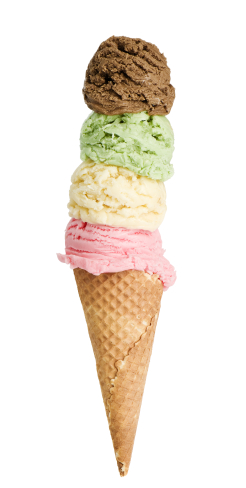
I scream for ice cream!

I like ice cream, me you know.

After handbags, shoes and earrings, a bit of sexy vanilla keeps this girl sweet.

I've tasted ice cream in at least 23 countires including Barbados, Belgium, Canada, Egypt, France, Germany, Greece, India, Israel, Poland, Spain and the United States- Miami and Florida keys 

After I had won BBC's Britain's Best Cook award I wandered around the West End in a daze trying to take it all in. Well after midnight I chanced upon Scoop Gelato in Shorts Gardens. I was amazed it was still open.  I told the proprietor that ice cream was my favourite.  He invited me in and let me sample almost every single flavour bar amaretto and green tea. He was really cute.  I was on top of the world.  The BBC trophy was in my hotel room.  I bought the biggest tub on offer and took it back to the hotel with me.  I scoffed it while soaking in the bath.

A week before the Royal Wedding I visited St. Andrews and saw where the Great Romance started. And I chanced upon Jannetta's in South Street.  Mmm .... yummy.  There is clearly more to St Andrews than golf and pier walks. 

So what about ice cream in Yorkshire? Two of my favourite gelateria are farms near Holmfirth.

There's Dearn Lea in Shelley.  The cone in the picture to the top right is one of theirs. 

And then there's Yummy Yorkshire near High Flatts. This is one of their tubs.  I had a scoop with a mince pie.

Both Dearn Lea and Yummy Yorkshire are working farms. You can visit the cows if you want though I'd prefer to visit the tea shop . The cows are very clean as are their quarters but even clean cows are a bit whiffy. If you must mither the moos sample your flavours first as you may not stomach it the other way round.